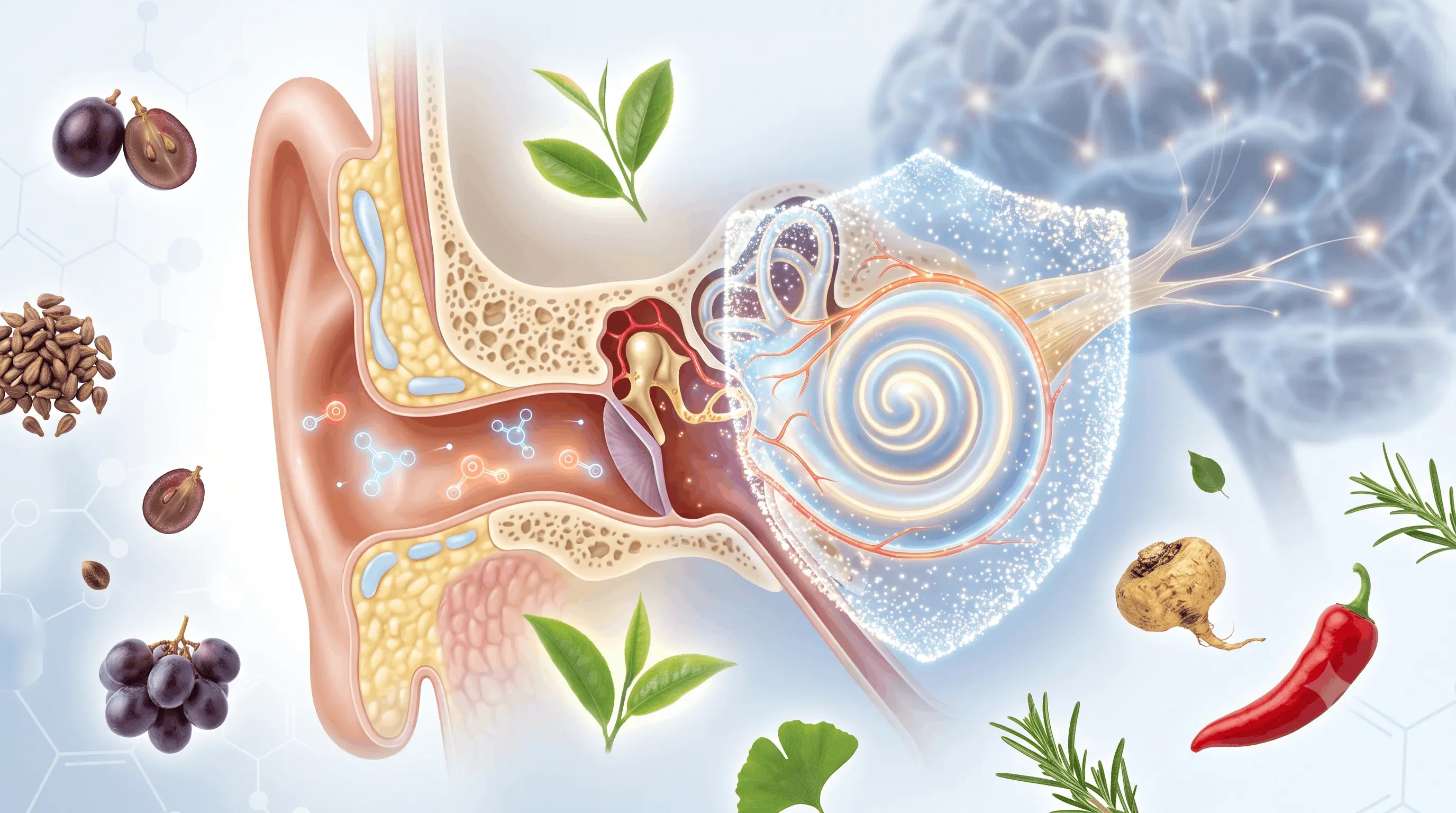
Most conversations about hearing health start and end with audiologists, hearing aids, and noise protection. Those things matter. But there's a less-discussed side of the equation: what you put into your body — the nutrients, antioxidants, and botanicals your auditory system depends on to function well — gets almost no attention until something goes wrong.
That's a problem, because the inner ear is one of the most metabolically active structures in the human body. It's constantly converting mechanical sound waves into electrical nerve signals, a process that demands steady blood flow, antioxidant protection, and a nervous system that can accurately transmit what the ear is picking up. When any of those elements are compromised, hearing quality declines — often long before a person notices a significant change.
This article breaks down the natural ingredients that researchers and nutritional scientists have been studying for their potential impact on auditory health, and explains why certain biological pathways matter more than most people realize.
The cochlea — the fluid-filled, snail-shaped organ responsible for hearing — contains roughly 15,000 hair cells per ear at birth. These cells are irreplaceable. Once damaged, they do not regenerate in humans. They respond to different sound frequencies, and their job is to translate vibration into an electrical signal sent to the brain via the auditory nerve.
The main threats to these cells are:
Understanding these mechanisms is why certain natural ingredients — not all supplements, but specific ones — draw legitimate scientific interest for auditory support.
The inner ear is particularly vulnerable to oxidative stress because its metabolic rate is so high. This is where antioxidants from food and plant-based sources can play a meaningful role.
Grape seed extract is rich in oligomeric proanthocyanidins (OPCs), a class of antioxidants that research has shown to be significantly more potent than vitamins C and E in neutralizing free radicals. Several animal and cell-based studies have specifically looked at grape seed extract's protective effects on cochlear hair cells exposed to loud noise or ototoxic substances. The hypothesis is that by reducing oxidative damage in the cochlea, antioxidants like grape seed extract may help preserve the structural integrity of the hair cells over time.
Green tea contains EGCG (epigallocatechin gallate), one of the most studied plant polyphenols for vascular and neuroprotective effects. What makes green tea particularly relevant to hearing health is its effect on blood vessel dilation and microcirculation. Since the inner ear depends entirely on its single blood supply, anything that keeps small blood vessels healthy and flexible has potential downstream benefits for auditory function. Green tea's anti-inflammatory properties add a second layer of relevance here.
The most effective approach to natural hearing support is not targeting the ear directly, but protecting the conditions the ear depends on — blood flow, antioxidant defense, and neural signal quality.
The cochlear artery is an end artery — meaning it has no collateral circulation to compensate if flow is reduced. This makes the inner ear exceptionally sensitive to any condition that impairs small blood vessel function: elevated blood pressure, poor cardiovascular health, chronic stress, or simply the stiffening of blood vessels that occurs with age.
Ingredients that support healthy microcirculation — things like green tea extract, capsicum compounds, and certain B vitamins — can play a genuine supporting role in maintaining the cochlea's metabolic environment.
Capsicum annuum, for instance, is primarily known as the source of capsaicin. Beyond its role in inflammation modulation, capsaicin has vasodilatory properties — it causes temporary widening of blood vessels, potentially improving peripheral and microcirculation. It's a counterintuitive ingredient to find in a hearing supplement, but the underlying mechanism is reasonable when you understand how dependent the inner ear is on consistent blood flow.
Hearing is not what happens in your ears. Hearing is what happens in your brain. The ear converts sound to electrical signals, but the brain performs the actual work of interpreting those signals — filtering noise, filling in gaps, and constructing a coherent auditory experience.
This is why ingredients that support nervous system function — like GABA, the primary inhibitory neurotransmitter — have genuine relevance to auditory wellness. GABA plays a particularly interesting role in this context: research has suggested that disruptions in GABAergic signaling may contribute to certain forms of auditory processing difficulties, including the perception of phantom sounds. Supporting relaxation of the nervous system isn't just about stress relief — it's about maintaining the neural environment in which sound processing occurs.
Gymnema sylvestre has a long history in Ayurvedic medicine, primarily for blood sugar support. Its relevance to hearing health is more indirect: by supporting healthy blood glucose regulation and nerve function, it may contribute to the metabolic conditions that healthy auditory nerve cells depend on. Diabetic neuropathy, for instance, is a well-documented risk factor for hearing loss — which illustrates how metabolic and neural health intersect with auditory function in ways most people don't consider.
Maca root is classified as an adaptogen — a plant that helps the body manage physiological stress responses. Its inclusion in a hearing support formula might seem tangential at first, but chronic stress has a documented negative impact on hearing health through multiple mechanisms: elevated cortisol constricts blood vessels (including cochlear circulation), stress-related inflammation increases oxidative burden on delicate ear tissue, and fatigue impairs the brain's auditory processing efficiency.
Addressing the body's stress response is therefore not an indirect approach to ear health — it addresses one of the core physiological mechanisms that compromises auditory function over time.
Not all hearing supplements are equal, and most of the market is flooded with low-quality single-ingredient products at doses too low to have any measurable effect. When evaluating a formula:
Audifort was formulated with this multi-pathway philosophy in mind. Its over-20-ingredient blend specifically addresses the key biological mechanisms we've covered here — antioxidant protection via grape seed extract, circulation support via green tea, inflammatory regulation via capsicum, and nervous system support via GABA. The liquid drop format also means faster absorption compared to tablet forms.
Over 20 plant-based ingredients. Liquid formula for easy daily use. 90-day money-back guarantee — even on empty bottles.
See Current Pricing →Natural supplements are not a substitute for hearing aids if significant hearing loss is already present, and they won't reverse damage that's already done. But the science is reasonably clear that the biological processes involved in maintaining healthy hearing — oxidative defense, circulation, inflammation, nerve signal quality — are all influenced by what you consume.
Prevention and ongoing support make more sense than waiting for a problem to become severe before acting. The cochlear hair cells you're protecting now are the ones you'll be relying on for decades to come.