It starts with asking someone to repeat themselves. Then you stop going to noisy restaurants because it's exhausting. Then family dinners become a performance of pretending to follow along. By the time most people act — 1 in 3 Americans over 60 already has measurable loss — years of preventable damage have quietly stacked up.
You don't wake up one day unable to hear. That's not how it works. It's much quieter than that — and that's exactly what makes it so easy to miss until it's already cost you something.
Maybe you've started sitting closer to the TV without thinking about it. Maybe you've caught yourself laughing at something in a group conversation that you didn't actually hear clearly, just to avoid the awkwardness of asking again. Maybe noisy restaurants have gone from annoying to genuinely exhausting — and you've started declining invitations because of it.
"I thought I was just tired. Or distracted. I didn't think it was my hearing — I'm only 52."
That's one of the most common things people say looking back. And it makes sense — nobody wants to be the person with hearing trouble. So we rationalize. We adjust. We withdraw a little bit at a time, so gradually we barely notice it happening.
Meanwhile, your spouse is repeating things more than they used to. Your kids think you're not listening. Your colleagues have started sending emails instead of stopping by your desk. And there's that quiet fear in the back of your mind — Is this going to keep getting worse? Did I wait too long?
If any of this sounds familiar, you are not alone — and you haven't waited too long. But understanding what's actually driving these changes, and what can be done about them, matters more right now than at any point later.
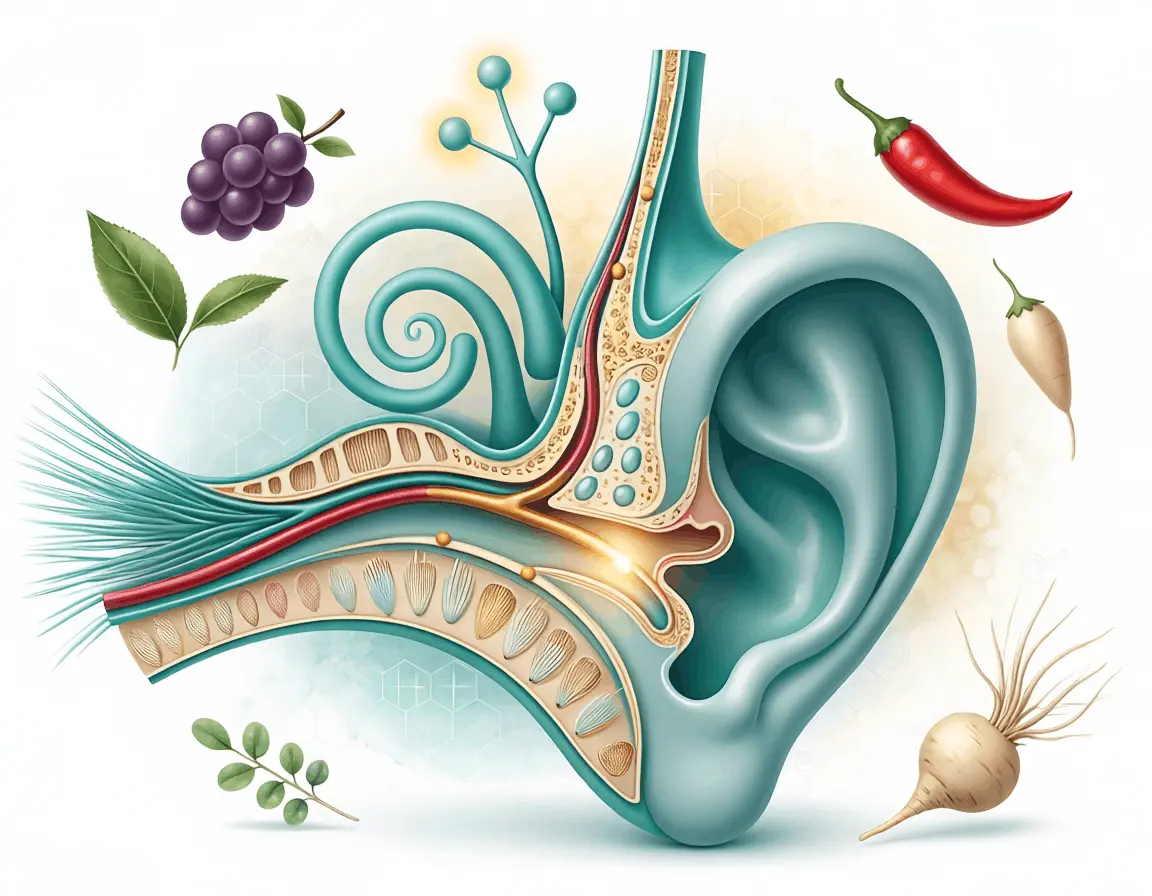
Inside your cochlea — the small spiral chamber deep in your inner ear — sit roughly 15,000 microscopic hair cells per ear. These cells are your entire hearing system. They translate sound vibrations into electrical signals your brain interprets as speech, music, and every conversation you've ever had.
Here's what almost nobody tells you until it's too late: these cells do not grow back. Not ever. Unlike skin, liver tissue, or even nerve cells in some areas of the body — cochlear hair cells have no regenerative ability in humans. Once they're damaged, they're gone. Permanently.
And the blood supply keeping all 15,000 of those cells alive runs through a single artery with zero backup circulation. One tiny vessel. No alternative route. No emergency supply line. If that flow gets even slightly compromised — by chronic stress, elevated blood pressure, inflammation, or the stiffening of small vessels that comes with age — your hair cells start starving quietly. Invisibly. Sometimes for years before you notice anything is wrong.
This is why the people who say "I wish I'd done something sooner" are not being dramatic. The biology of hearing decline doesn't wait for you to be ready. It just shows up one day in a noisy restaurant when you realize you've missed the punchline of a story your grandchild was telling you.
Most people assume hearing loss is caused by loud noise or just getting older. That's only part of the picture. The 6 mechanisms below are what's actually driving the majority of age-related hearing changes in Americans 35–65 — and almost none of them get talked about in plain English.
When people first notice hearing difficulty, they typically do one of three things. None of them actually address what's causing the problem.
Once you understand that hearing decline is a biological process — driven by oxidative damage, circulation, inflammation, and neural chemistry — the question becomes: can any of these things be influenced nutritionally?
The honest answer, based on the research, is yes. Not perfectly. Not for everyone. But meaningfully enough that serious researchers have spent decades studying specific plant compounds for exactly this purpose.
That's the logic behind Audifort. Not a miracle. Not a cure. A daily nutritional formula built around the biological pathways that actually matter for long-term hearing wellness.
Read the full ingredient science breakdown →
One of the most consistent things customers mention is how easy Audifort fits into their morning. A few drops. That's it. No capsules, no measuring, no dedicated "supplement moment."
The formula is non-habit forming, so there's no concern about dependency. Just daily nutritional support for the systems that matter.
Over 20 carefully chosen plant-based ingredients — each selected because it addresses a specific biological mechanism behind hearing health, not just because it sounds good on a label.
Helps the body manage the physiological effects of chronic stress — including the cortisol-driven blood vessel constriction that reduces inner ear circulation. Less cortisol, better blood flow to the cochlea.
Contains proanthocyanidins shown to be significantly more potent than vitamins C and E at neutralizing free radicals — directly relevant to protecting the metabolically active hair cells inside your cochlea.
Green tea's EGCG compounds support blood vessel flexibility and microcirculation — directly feeding that single cochlear artery that has no backup. Secondary antioxidant protection included.
Capsaicin compounds support the body's natural inflammatory regulation pathways — addressing one of the key mechanisms behind age-related auditory tissue degradation most people never connect to hearing.
Supports healthy nerve function and metabolic conditions — relevant because diabetic neuropathy is a documented risk factor for hearing decline. Healthy nerves carry healthy signals to the brain.
The brain's primary inhibitory neurotransmitter regulates how accurately your auditory cortex processes sound. Disrupted GABA signaling is linked to conditions including tinnitus. Supporting it supports the whole hearing system.
Most supplements pick one angle. Audifort was built around the understanding that hearing health is a multi-system issue, and a multi-system formula is the only approach that makes biological sense.
If the TV volume, the noisy restaurant problem, or the slight withdrawal from social situations sounds familiar — you're not unusual, and you're not overreacting. These are the early signs that millions of Americans experience and millions dismiss. The ones who do something about it early are the ones who don't end up in an audiologist's office at 70 wishing they'd paid more attention at 50. These are a few of the people who didn't wait.
Results vary — but every word below is theirs, unedited.
"I treasure my peace and quiet more than anything. So I'm well aware just how important the health of my ears is. Knowing that by taking Audifort I'm feeding my hearing these essential nutrients helps me sleep better at night. Definitely give this one a try."
"It's only been three weeks since I started taking Audifort, but I love how easy it is to take and how well it works to support my mental sharpness. I put a couple of drops in my morning coffee and just go on my way. I've even shared it with a few friends and they're already coming back for more."
"At 58 I was starting to notice I'd ask people to repeat themselves more than I used to. After about 6 weeks on Audifort I honestly feel more present in conversations. The morning brain fog has also noticeably improved. I didn't expect both — but I'll take it."
Andrew Ross spent years researching the intersection of plant-based nutrition and auditory health before developing the Audifort formula. He wasn't a supplement industry insider — he was someone who got genuinely curious about why so many people lose hearing gradually without any obvious single cause, and what the research actually showed could be done about it.
The formula he developed reflects that research: not a single-ingredient product chasing one mechanism, but a comprehensive blend addressing the four main biological drivers of age-related hearing change. He backs every bottle with a personal 90-day money-back guarantee because he believes in letting the results speak.
These aren't filler bonuses. Both books extend Audifort's approach into two areas — sleep and brain health — that directly influence how well the formula works over time.

Your brain does critical auditory system maintenance during deep sleep — a process most people are unknowingly shortchanging. This guide covers natural methods for improving sleep depth and consistency. Better sleep is not a nice-to-have here. It's part of the strategy.

Since hearing is fundamentally a brain process, this guide focuses on natural strategies for supporting the neural pathways involved in auditory processing — cognitive sharpness, neurotransmitter balance, and the brain's ability to interpret what the ears send it clearly.
Zero Risk
Try Audifort for a full 90 days. If you're not satisfied — for any reason — return the bottles (even empty ones) for a complete refund within 48 hours. Andrew Ross stands behind this formula personally. You're not gambling anything here. You're just giving your hearing the chance it deserves.
Start My Risk-Free 90-Day Trial →Most customers who see the best results use Audifort for at least 90 days. 96% of orders are for the 6-bottle package — the best value with free US shipping.
👆 Click the image or select a package below
Questions? Every order is covered by the 90-day money-back guarantee — even empty bottles. Zero risk to try.
If you want the full science behind what's on this page, these two articles go considerably deeper — written in plain English, no jargon.
Most people wait until hearing difficulties become genuinely disruptive before doing anything. Audifort is for people who'd rather be proactive — who'd rather support the biological systems behind good hearing while there's still time to make a real difference. Try it risk-free for 90 days.
Claim My Audifort Before Price Increases →90-Day Money-Back Guarantee · Secure Checkout via ClickBank · Made in the USA